
We're aware that some organisations are promoting fake Quantum AI schemes; we're not addressing this here.
You can find out more about these schemes at the UK Financial Conduct Authority or London Academy of Trading
Anyone concerned with data security will already be familar with the acronym PQC - Post-Quantum Cryptography. It's about being prepared if. and when quantum computers become a reality.
Right now, that date could be far in the future; it could even be never. There's an authoritative body of opinion that says they're impossible. But they already exist, albeit in rudimentary and error-prone form. Powered flight was impossible until 1903, and then could be dismissed as a toy. Eleven years later it had become a weapon.
Today, many of us fear that AI could become a self-determining weapon of mass destruction. That may happen, but the toothpaste is out of the tube and can't be squeezed back in, so I suggest we look at aspects of AI that are more under our control.
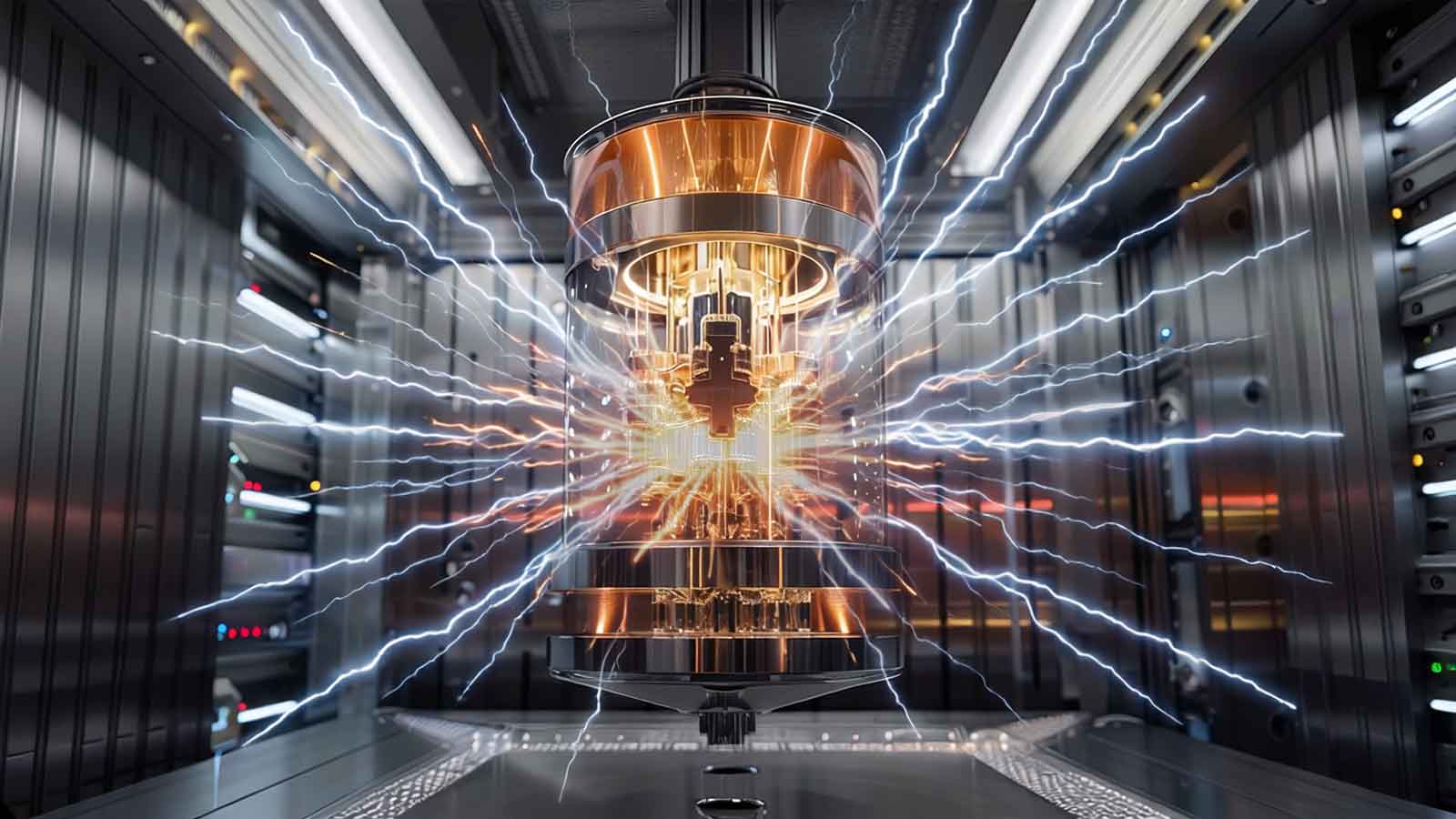
Instead of bits, which can be 1 or 0, quantum computing uses qubits, which can be both at the same time. Put simply, where a normal computer can test one possibility at a time, albeit extremely rapidly, a quantum computer can test all possibilities at the same time1.
Now consider a brute-force attack on a database. A modern computer bot of only moderate capability can achive anything up to a billion guesses per second. Enterprise cracking rigs, as deployed by some hostil governments, can achieve more than seven trillion tries in the same second. RSA encryption can withstand such a straightforward attack for more than a million years (barring the one lucky guess that could happen on every attempt). Shor's algorithm running on a quantum computer could crack it in hours.
But is this a serious threat today? While emerging regulatory mandates will force financial and other institutions to adopt PQC, the timeline targets are long, and quantum computing is currently primitive, unreliable and may even prove to be a dead-end. But AI is accelerating just about every technology, so timescales could change with frightening speed. This isn't just another ISO20022 deadline that can stay on the back burner long after deadlines have expired; this is a real threat today.
It's worth bearing in mind that encrypted data stolen today can be decrypted tomorrow. It's known that bad actors are already stealing long-lived data for decryption when the technology becomes available. And when quantum computing - or something as yet undreamt of, amde possible by AI - becomes available, RSA or ECC algorithms will evaporate within hours. The technology to read your data might not yet be here, but it's already being stolen in preparation for when the technology arrives.
Our DotLedger was built using Post-Quantum Cryptography on day one. It might even have been the world's first natively PQC-ready stirage platform. Penetrating the storage in the first place is a challenge far beyond blockchain, but even should a penetration ever happen, it will meet cryptographic algorithms that will keep a quantum computer busy for the next couple of thousand years.
DotLedger was invented by a published cryptographer, who's still here, heading up our continuing development of our federated ledger. If you take cyber-security seriously, you can talk to him direct. He can show you how to stop worrying about something that, right now, you should be worrying about. Drop me a message on LinkedIn or leave a message on our Contact page and we can talk about it.
1: Like most simplifications, this isn't entirely correct, but it'll do for now.

CertiQi Limited
Emperor's Gate
114a Cromwell Road
London
United Kingdom
SW7 4AG
Copyright ©2026, CertiQi Limited